
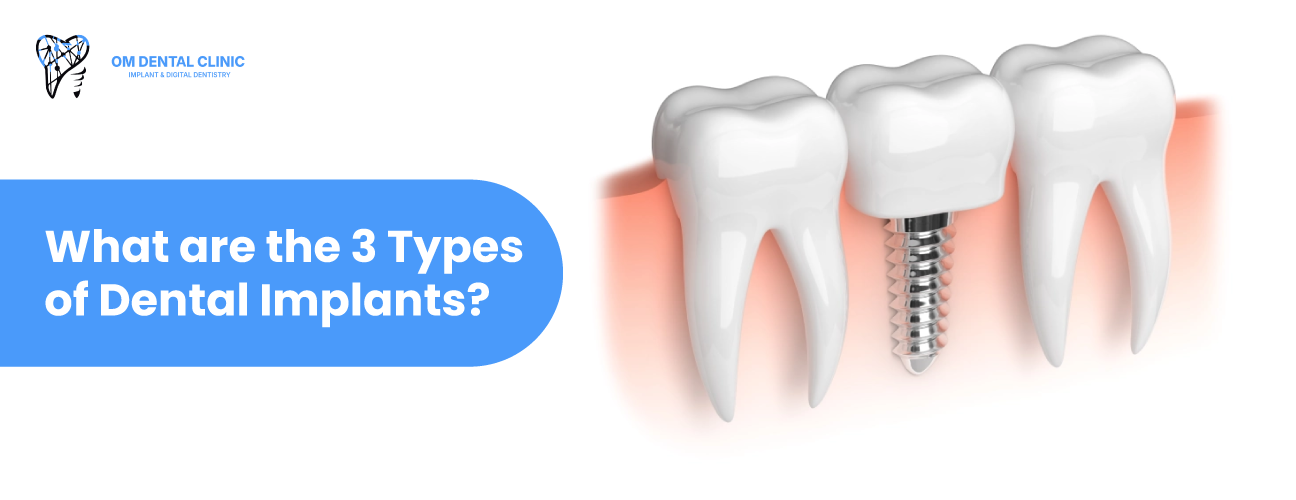
If you’re missing teeth and looking into implants, you may be wondering about the 3 types of dental implants and which one might actually suit your situation. It is a common concern because the choices can feel confusing in the beginning.
Dr. Komal Majumdar at Om Dental Clinic informs the patients about their options, considering bone health, budget, comfort, and long-term goals.
We’ll focus on the 3 types of dental implants, what they mean, when they are used, and how to choose in a way that feels informed instead of rushed.
A dental implant is considered to be a small device made of some material that is surgically implanted within the jawbone. This acts like the substitute for a missing tooth’s root, and with the healing of the bone around it, the implant goes on to support a crown or a bridge, or even implant-supported dentures.
This involves a kind of process called osseointegration: the fusing together of the bone and implant. They are preferred by people, as they are stable, long-lasting, and have a natural appearance.
The treatment becomes relevant when a tooth is lost due to decay, trauma, or gum issues, or when removable dentures feel uncomfortable or embarrassing.
You get something that stays in the mouth and lets you speak or chew in a normal way, which is why many people prefer the option.
There are different types of dental implants and they are chosen depending on bone level, number of missing teeth, and what the patient expects.
When the bone is strong, the approach is different compared to cases with bone loss. So let’s break down the 3 types of dental implants in a realistic and patient-friendly way.
The most common type is the endosteal type. This implant is set directly into the jawbone, and then it is allowed to simply heal prior to the crown or bridge that will be placed later. This is often used for a single-tooth implant vs. multiple-teeth implant situations. Patients who want something sturdy usually go for this, since the implant sits deep inside the bone. The bonehead success rate is much higher in healthy bones, and this is from proven research.
However, they are widely accepted because they offer a natural-feeling chewing experience, especially after the recovery process is complete.
Another aspect worth considering is the need for sufficient quality and volume of bone in order to opt for this choice. If one is lacking, one would need a bone graft. However, this is not a con, just part of the process in order for the choice to last longer.
Subperiosteal implants are placed on top of the jawbone but below the gum. These implants help patients who lack the bone volume required for an endosteal implant or people who do not want bone grafting. This approach might be suitable for someone with major bone loss.
The biggest advantage is that the surgery may be less extensive since the implant does not go deep into the bone. The disadvantage is that the success rate can be lower and the stability might not match an endosteal option. This means subperiosteal implants are less common in modern practice, yet they can be a good bridge solution when a bone graft is not preferred.
Endosteal vs. subperiosteal implant choice is based on bone height and medical condition, so guidance matters a lot.
The third group includes specialized implants. These include zygomatic dental implant systems and full arch dental implants. Zygomatic implants anchor into the cheekbone when the upper jawbone is too weak. Full arch solutions can help patients restore many teeth at once without placing an implant for each missing tooth. This approach is sometimes called immediate load or All-on setups, and it is used when the patient wants faster replacement or when bone volume is low.
The advantages are quite appealing. You can avoid long bone grafting in some cases, and it can restore smiling and chewing function quickly. The main thing to understand is that this option requires more planning and experience. It may cost more and not all clinics provide it.
So this type is ideal for severe bone loss or full mouth dental implants in koparkhairane cases when a complete transformation is needed.
You should never have to guess which implant is best for you. You should pay close attention to things like how many teeth you are missing, and how strong your bones are.
At Om Dental Clinic, we use advanced imaging and thorough jaw assessments to check the health of your bones and make sure your treatment is planned correctly.
Dr. Komal Majumdar walks you through every step of the process so you know what to expect and feel good about your implant treatment.
A single missing tooth may call for an endosteal option, while a person missing many teeth with low bone may go for specialized choices. Cost and healing time matter too.
For example, some patients want a quick fix but others want a long-term fix even if the process takes more time.
Before you decide, it helps to ask questions like, “Do I have enough bone?” Will I need a bone graft? What is the best long-term choice? Once those questions are answered, the picture gets clearer.
Not sure which dental implant option suits you best?
You can book a consultation so a dentist can check your jawbone and guide you toward the right solution. Dental clinics in Koparkhairane vary, so professional advice is smart.
Picking the right implant type helps avoid risk and improves implant success rates. You get better chewing, better speech, and a smile that feels natural. It also helps in preserving bone and facial shape since implants keep pressure on the bone.
When matched well, the implant lasts long and you feel more confident about your mouth. A bad match might fail, so the choice is the foundation for success.
A common myth says any implant can replace any missing tooth. The truth is bone and implant size are linked closely.
Another myth says implants are only for young people. The fact is bone and health decide more than age.
There are those who believe that implants should not have check-ups, but implant success, even for the long term, entails oral hygiene and periodic check-ups.
Patients should make themselves aware that an implant is strong but the gum and bone surrounding it still have to be taken care of.
After healing, the abutment and crown/bridge are inserted. It is essential to care for the implant as you do natural teeth and avoid smoking since it impedes healing.
Instructions on how to carry out home care will be provided by the clinic, and follow-ups are done to ensure that the bone and gum are healing well.
Endosteal goes into the bone and subperiosteal sits above it under the gum. Bone level decides which is suitable.
It can last many years with proper care and checkups.
Yeah, but maybe a transplant or an option considered for its value according to demands for bone graft implants.
There can be surgical risks, cost concerns, and strict planning requirements.
The initial investment may be higher, but the long-term value is usually worth it.
Bone health, gum conditions, health problems, and hygiene practices make a difference.
You now know the 3 types of dental implants and why each option exists. Endosteal gives stability for many cases. Subperiosteal is useful when the bone is poor and grafting is contraindicated or undesirable. Specialized procedures, zygomatic implants or full-arch implants are useful in very bad cases to replace multiple teeth.
The choice depends on bone, missing teeth, personal health, and expense. The best course is usually to talk it over with an expert dentist.