
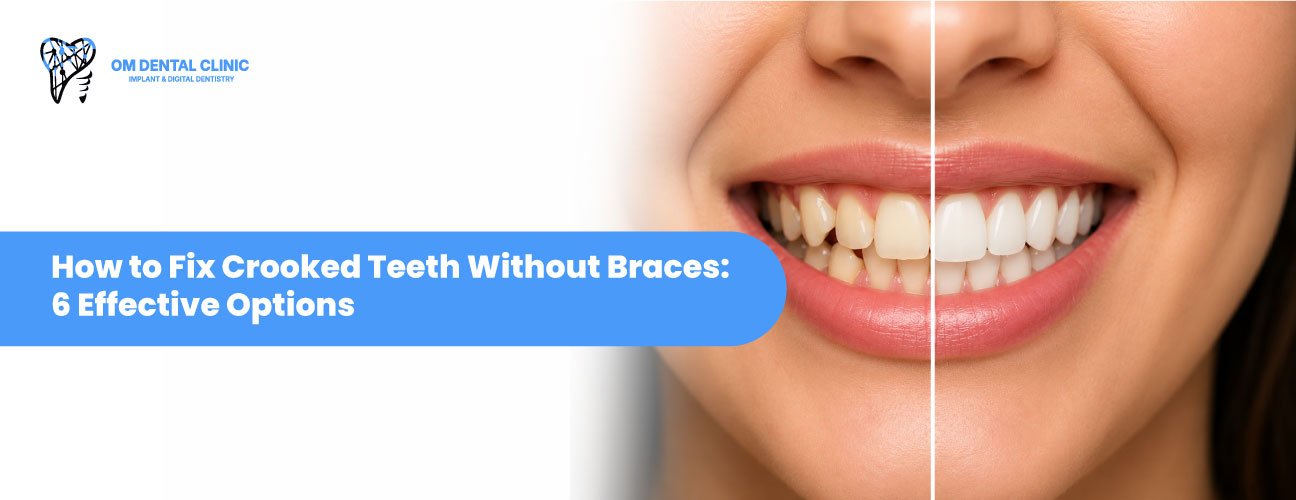
Yes, crooked teeth can be corrected without braces, but the right treatment depends on the degree of misalignment and the health of your mouth.
Modern dentistry has many options besides traditional braces such as clear aligners, dental veneers, dental bonding, crowns and in rare cases even tooth contouring. In mild to moderate cases, treatment without metal braces is typically possible, but difficult alignment problems may still require orthodontic treatment.
Crooked or misaligned teeth are very prevalent and can impact your confidence and oral health. A lot of people feel shy when they talk to people or are reluctant to smile for pictures due to uneven teeth.
Braces have been the standard for years, but they’re not the only option. Today, adults and teens have discreet, comfortable and speedier options to improve the look of their smile without traditional metal brackets and wires.
In this guide we’ll go through six effective techniques to repair crooked teeth without braces, who each procedure is ideal for, and help you understand which option might be right for your smile.
Before we dive into the solutions, let’s briefly discuss why teeth develop crooked in the first place. The most prevalent cause is genetics (the size and form of your jaw and teeth are mostly inherited) but other causes include early tooth loss, childhood habits like thumb-sucking or extended dummy usage, and injuries that cause teeth to be shifted out of position. In other cases, the underlying issue is just crowding and there isn’t enough space in the jaw for all the teeth.
The treatment option will depend on the reason and severity of your imbalance.
For those patients that need true tooth mobility, clear aligners are more popular than traditional braces. They use the same orthodontic idea as braces to move teeth gradually into the right position over time, but they do it with a series of custom-made, clear, plastic trays that you wear over your teeth.
You wear each pair of aligners for around two weeks, then move on to the next set in the series. They are worn by most patients for 20 to 22 hours a day, being taken off only to eat, drink and brush. Depending on the complexity, treatment may take a few months to more than a year.
The advantages over braces are obvious: they are almost undetectable, detachable, and produce less friction and irritation within the mouth. They work best for mild to moderate misalignment and are especially popular with working adults who want to straighten their teeth without anyone seeing.
If you want to know how long the straightening treatment takes, then our guide to how long braces take to straighten teeth presents a useful comparison between the different ways.
Porcelain veneers are thin shells that are specifically made and adhered to the front surface of your teeth. They don’t actually shift teeth, but can make a huge difference to the way your smile looks by hiding minor misalignment, gaps, chipping, unequal lengths and discolouration all in one.
When the misalignment is small and more of a cosmetic issue than a biting issue, veneers are a great option. The outcomes are rapid, there is no protracted therapy period. These veneers seem perfectly natural once placed, are stain resistant and very robust, lasting on average 10–15 years with good care.
It is a permanent modification as the treatment entails removing a little bit of enamel from the tooth surface to make room for the veneer. This is something to discuss with your dentist before moving forward.
One of the fastest and most affordable cosmetic dental procedures is dental bonding. This involves placing a tooth-coloured composite resin right on to the tooth and shaping and sculpting it to rectify slight misalignment, close small gaps or smooth out uneven edges.
Bonding is more conservative than veneers since it does not involve a large amount of enamel loss. Usually, the surgery is done in one appointment. The resin is colour matched to the natural shade of your teeth for a seamless blend of outcomes.
Bonding works well for little imperfections and is not a solution for severe crowding or biting concerns. And it is not as lasting as veneers, and can require a touch-up every 5-10 years especially if you eat a lot of staining foods or drinks.
A dental crown is a covering that fully covers a broken or deformed tooth. Crowns are mostly used to heal and protect broken teeth, but they can also be used cosmetically to improve the size, shape or position of a tooth that makes your smile look uneven.
Crowns are most useful if a crooked tooth is also structurally impaired such as after root canal treatment, a big filling or substantial wear. In this scenario, a crown solves the visual problem as well as the functional problem at the same time.
Crowns, like veneers, are a permanent fix and require some preparation of the original tooth. These are usually manufactured from porcelain, zirconia or a combination of the two to match the colour of your surrounding teeth.
Teeth contouring, also known as tooth reshaping or enameloplasty, is a modest cosmetic operation that involves careful removal of small portions of enamel to change the form, length or surface of a tooth. It is one of the easiest and quickest operations in cosmetic dentistry, generally accomplished in a single visit and without the need for anaesthesia.
Contouring is a good fix for teeth that are a little overlapping, have uneven edges or look pointed or irregular. Often used in conjunction with dental bonding for more complete results. Contouring smooths and reduces where necessary, bonding adds and builds up where necessary.
This entails removing enamel ( which can not grow back ) . So it is only acceptable for circumstances when very slight modifications are needed .
Many people think of retainers as the follow-up to braces, however for adults with very modest misalignment, a bespoke retainer can occasionally be used as a primary treatment to guide teeth into a slightly better position. This is only appropriate in very mild cases and would be decided by your dentist after an examination.
Retainers are a low-commitment solution when appropriate. They can be detachable, inconspicuous and generally comfortable.
Set realistic expectations about what can and cannot be achieved with non-orthodontic options. Veneers, bonding and contouring change the appearance of your teeth but do not really shift the position of the teeth in your jaw. If you have severe crowding, wide gaps between your teeth, an overbite, underbite, or crossbite, or any misalignment that impacts chewing and jaw function, orthodontic treatment, whether traditional braces or clear aligners, is still the medically appropriate course of action.
A good dentist will always be frank if a cosmetic treatment is really appropriate for your case, or if underlying alignment concerns need to be treated first. For example, using veneers to cover a biting problem can create to problems later on.
If you decide to undergo braces treatment, the initial few days of adjustment are a vital part of the procedure, and our guide on what to eat with braces in the first week can help you get through this phase in comfort.
Look at it this way:
The only way you can tell for sure is to get a professional dental evaluation. X-rays and a bite assessment enable your dentist to see the entire picture of what is happening below the gum line and inside the jaw, which is important information for making recommendations for the correct treatment.
If you want to straighten your smile with aligners, veneers, bonding or a mix of these, Om Dental Clinic can provide you with a complete range of cosmetic and orthodontic options for a straighter and more confident smile.
If you are in Navi Mumbai and seeking for professional help, our dental clinic in Ghansoli is just around the corner. We can check on your teeth and tell you all the options you have.
No pressure, no cookie cutter approach, just honest expert advise for your smile and your goals.