
Tooth pain can be confusing. One day you notice a bit of sensitivity, the next you’re wondering whether your dentist is going to suggest a simple filling or something more involved like a root canal. The truth is, both treatments are designed to save your natural tooth, but they address very different stages of tooth damage. Understanding the difference can ease your anxiety and help you walk into your appointment feeling informed.
One of the most frequently performed dental treatments is dental filling. This treatment is recommended when there is a decay in the form of a cavity in the teeth, and this cavity can be found only in the outer layer of the tooth, namely, the enamel and dentin layers. During the dental filling procedure, the dentist will extract the decayed part and fill it with dental filling materials like composite resins, porcelain, or dental amalgams.
Fillings are straightforward, minimally invasive, and are typically completed in a single appointment. They are also the more affordable option and, when placed early enough, can actually prevent you from ever needing a root canal.
If these signs sound familiar, do not delay. Early treatment with a filling is far simpler and far less expensive than waiting until the problem worsens.
What Is a Root Canal Treatment?
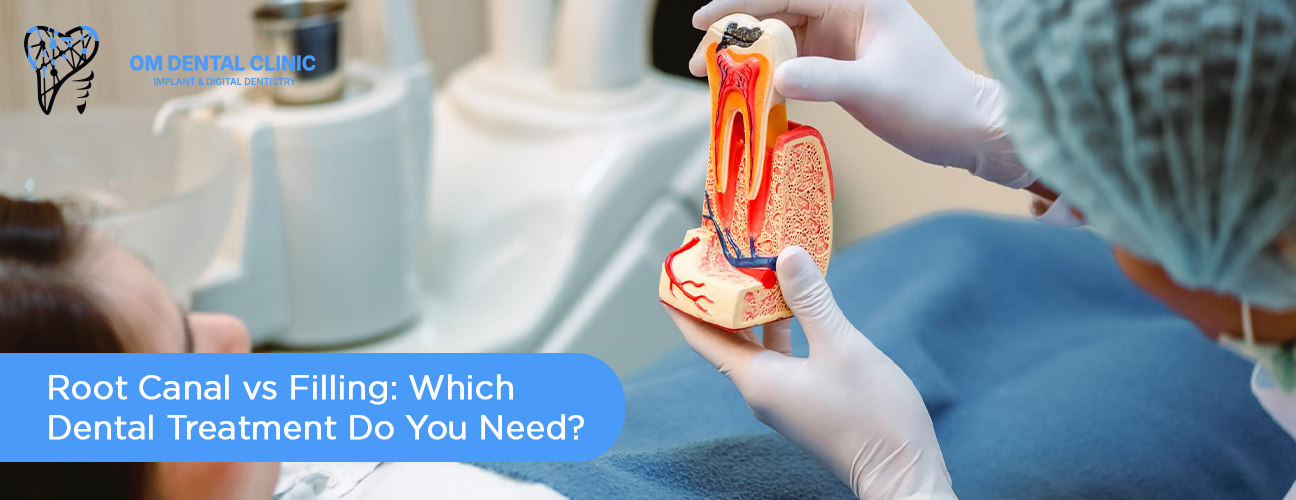
A root canal goes several steps further than a filling. At this point, the condition of the tooth cannot be fixed by a simple filling. In essence, the goal of root canal procedure is to clear out the diseased and inflamed tissue in the tooth so as to get rid of the infection.
During root canal procedure, the infected pulp is removed from inside the tooth. After the pulp has been removed, root canals are then cleansed, shaped, and filled using a safe filling material called gutta-percha. In most cases, after this procedure, a crown is added to the tooth in order to protect and preserve its functionality.
Despite its reputation, a modern root canal is not the painful ordeal many people imagine. With local anaesthesia and today’s techniques, most patients report that the procedure feels no more uncomfortable than getting a filling. More importantly, it relieves the significant pain caused by pulp infection, rather than causing it.
If you are looking for expert root canal treatment in Koparkhairane, the team at Om Dental Clinic is experienced in making this procedure as comfortable as possible.
| Feature | Dental Filling | Root Canal Treatment |
| Stage of decay | Enamel and dentin only | Pulp (nerve) is infected or inflamed |
| Goal | Remove decay, restore tooth shape | Remove infected pulp, save the tooth |
| Number of visits | Usually one | One to two visits |
| Pain during procedure | Minimal, local anaesthesia | Comfortable, local anaesthesia |
| Recovery time | Short, mild sensitivity only | A few days of mild soreness |
| Restoration needed | Filling only | Filling + crown (usually) |
| Cost | Lower | Higher due to complexity |
This is a question worth taking seriously. When tooth decay is caught early, a filling solves the problem quickly and affordably. But if decay is left untreated, the bacteria continue to eat through the tooth. Eventually, they reach the pulp and cause an infection that can spread to the surrounding bone and tissue.
At that point, the options become more limited: either a root canal to save the tooth, or an extraction. Losing a natural tooth then requires further treatment such as implants, bridges, or dentures which are more involved and more expensive than the original filling would have been. Timely visits to a dentist in Koparkhairane are the simplest way to stay ahead of this progression.
This is a common question, and the honest answer is: not when the pulp is already involved. Placing a filling over an infected tooth simply masks the underlying problem. The infection continues beneath the surface, often becoming significantly more painful and damaging over time. Conversely, if the pulp is healthy and the decay has not reached it, a filling is the appropriate and preferred treatment, no root canal needed.
Your dentist will determine which treatment is right for you based on a clinical examination, your reported symptoms, and dental X-rays. Symptoms alone do not always tell the full story; sometimes a tooth in need of a root canal causes very little pain, particularly if the nerve has already died.
After a filling: You may notice mild sensitivity for a day or two, particularly to temperature. Avoid very hard or very sticky foods for 24 hours and you should be back to normal quickly.
After a root canal: Some soreness and mild swelling are normal for two to three days after the procedure. Over-the-counter pain relief is usually sufficient. Adjustment in your diet is necessary when you’re recovering from the procedure, which means eating only soft foods and refraining from eating things that are too hot and hard. You can find information on your diet during this time frame from our diet after a root canal article.
Good oral care and regular checkups will be crucial in either case to ensure the well-being of your treated tooth.
Prevention is always the best strategy in dentistry. Here are the habits that make the biggest difference:
Do not wait for pain to become unbearable before seeking help. In case you experience any of the following, do not delay making an appointment:
Early detection of any problem will result in easier treatment and cost savings.
Both fillings and root canals are effective, routine procedures that serve the same ultimate purpose: saving your natural tooth and restoring your oral health. The right choice depends entirely on how far the decay has progressed. A filling is the right answer when the problem is caught early. A root canal becomes necessary when the infection has reached deeper into the tooth.
Either way, modern dentistry has made both procedures far more comfortable than most people expect. If you have been putting off a dental visit out of anxiety or uncertainty, we encourage you to come in for an assessment. Addressing the issue sooner almost always means less treatment, less discomfort, and less cost.
At Om Dental Clinic in Koparkhairane, Navi Mumbai, our team is here to guide you through every step, from diagnosis to treatment to recovery. Book your appointment today.