
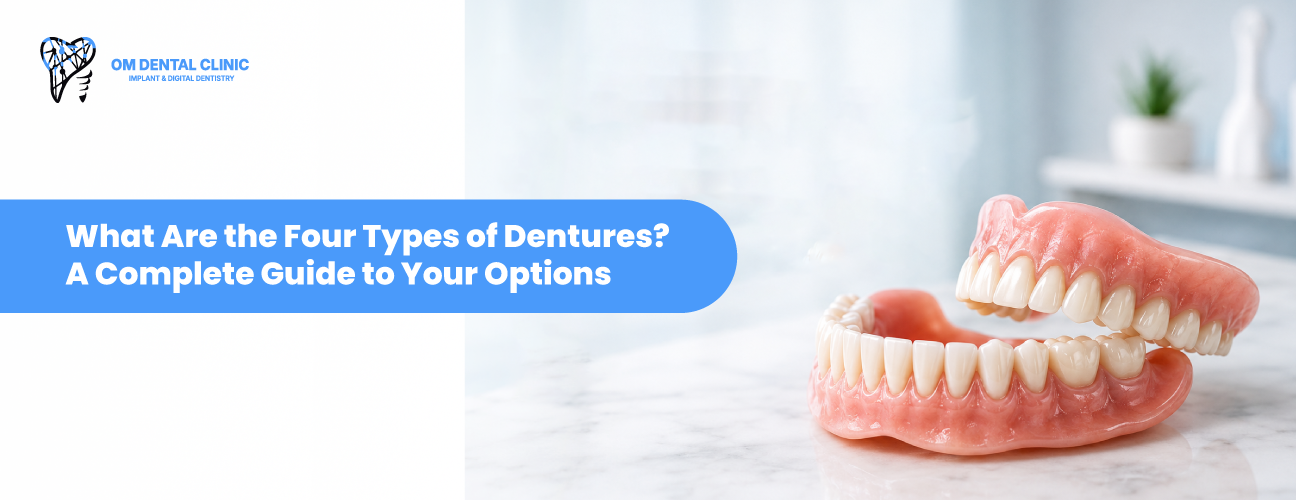
The four primary forms of dentures include complete dentures, partial dentures, implant-supported dentures and instant dentures. Each type is intended to replace missing teeth, depending on your oral health, how many teeth you’ve lost, your jawbone condition and your long-term dental goals. Complete dentures replace all the teeth in an arch, whereas partials are used to repair gaps between healthy natural teeth. Implant-supported dentures are more secure and quick dentures allow you to leave the dentist facility with replacement teeth the same day as your extraction.
Four Types of Dentures at a Glance
If you are missing one or more teeth and are considering your alternatives, dentures remain one of the most effective and economical ways to replace teeth. However, knowing the differences between each variety will help you make an informed decision. This article will help you understand the four varieties of dentures, what they are, how they operate, pros and cons for each, and who they’re ideal for.
Dentures are custom-made dental appliances that replace lost teeth and restore the appearance and function of your smile. They are designed to seem like natural teeth and gums and can be detachable or permanently attached, depending on the type.
Dentures are vital to a person’s appearance and function as teeth. They help you chew food properly, talk more clearly and maintain the face muscles which often start to sag after losing teeth. Today’s dentures are much more comfortable, realistic and lasting than what most people may imagine from decades before.
When all teeth in the upper jaw, lower jaw or both are missing, complete dentures or full dentures are utilised. These are a full set of fake teeth on an acrylic basis that is coloured to match the gum. The denture base rests directly on the gum tissue.
Complete dentures are detachable and are secured by natural suction, the contour of the mouth and if necessary, a dental glue. They are specifically manufactured using impressions of the patient’s mouth to fit as best as possible.
Who is this for? Complete dentures are perfect for those individuals who have lost all of their teeth due to decay, gum disease or injury, and want to restore their smile and ability to chew without surgery in a cost-effective method.
One of the things to think about with complete dentures is that the jaw bone changes shape over time once the teeth are lost. This implies the dentures may have to be relined or readjusted from time to time to keep them comfortable and secure.
Partial dentures are made for people who have some good natural teeth left. A partial denture is not meant to replace a full arch. It fills the spaces of one or more missing teeth and uses the remaining teeth for support and stability.
A typical partial denture has a gum-coloured base with replacement teeth attached to it and joined together by a metal or acrylic framework. Small clasps engage the adjacent natural teeth to hold the denture in place during use. Partial dentures, like full dentures, are removable.
Who is that for? Partial dentures are a good option for people who have lost many teeth but still have enough healthy teeth remaining to support the device. They also prevent the other remaining natural teeth from sliding or tilting into the vacant spaces, a typical condition that can compromise bite alignment over time.
Note on LSI: Partial dentures are often called detachable partial dental prosthesis or partial plates in everyday usage.
Immediate dentures are inserted the same day the remaining teeth are pulled. Patients leave the clinic with a temporary prosthesis in place instead of waiting weeks or months for the gums to recover completely before the denture is fitted.
This type of denture is pre-made from imprints taken before the extractions. Once the teeth are taken out, the instant denture is placed immediately so the patient is never without teeth.
Who is this for? Immediate dentures are very useful for patients who are concerned about the cosmetic and social effects of being edentulous throughout the healing time for work, family occasions, or overall self-confidence.
However, you should remember that instant dentures are generally a temporary solution. The fit will alter over the coming weeks and months as gums recover and the jawbone reshapes. Often adjustments are needed, and in many situations, a final, permanent denture is constructed after healing is complete.
Today, the most modern and stable denture alternative is the implant-supported denture. Unlike traditional dentures that sit on the gums, these are attached to dental implants where tiny titanium posts are surgically implanted into the jawbone to replace the roots of missing teeth.
There are two basic options: removable implant-supported dentures (also termed snap-in or overdentures) that may be taken out for cleaning, and fixed implant-supported dentures that are permanently affixed and can only be removed by a dentist.
The main benefits of implant-supported dentures over conventional dentures are that they are more stable, provide better chewing power and the fact that the implants stimulate the jawbone and therefore help avoid the bone loss that usually occurs after tooth loss.
Who is it for? Implant-supported dentures are a great long-term investment for patients looking for the closest feel to genuine teeth, or for individuals who have encountered instability or pain with regular dentures. They are particularly advised for patients who are considering full mouth dental implants as a treatment for total tooth replacement.
The subject of dentures vs implants is generally asked in its entirety. The answer depends on your bone density, budget, health and how many teeth you’re missing.
Traditional dentures rest on the gums and do not require surgery. They are usually cheaper in the outset and will work for a wide spectrum of patients. Dental implants are surgically positioned into the bone. The advantage of implants is stability and long term maintenance of the jaw structure .
For many patients, the best solution is somewhere in the middle, implant-supported dentures that combine the coverage of dentures with the security and bone-preserving benefits of implants.
There is no single best denture for all people. The optimal type will rely on a mix of criteria your dentist will evaluate:
If all teeth are lost, the likely options are full or implant supported dentures. Partial dentures may be the better fit if some teeth remain.
To hold the implants, dentures that are implant supported require enough jaw bone density. Bone graft may be needed if there is not enough density.
Implant supported solutions need surgery and a healing period of many months, but complete and partial dentures are usually less expensive and easier to obtain.
Implant supported solutions may be preferred for those who want maximum stability to be able to eat a varied diet or for professional confidence.
The best method to find the perfect decision is to have a proper dental evaluation comprising x-rays, gum assessment and a discussion of your goals.
Once you have your dentures, the key to keeping them clean, comfortable and long-lasting is proper maintenance. Brush your dentures regularly using a soft-bristled denture brush and non-abrasive denture cleanser, not regular toothpaste, which can scratch the surface and provide spots for germs to grow.
Soak dentures in a mild denture solution or plain water overnight to prevent them from drying out and warping.
For a detailed step-by-step regimen, see our guide on cleaning dentures at home as it includes tools, techniques and pitfalls to avoid.
Regular check-ups with your dentist are still vital, even if you have a full set of dentures. As your gums and bone shrink, you’ll need frequent relines so your denture fits comfortably and properly.
Whether it’s your first time thinking about dentures or you’d like to replace your present dentures, it’s important to seek the correct guidance from an experienced dental staff.
At Om Dental Clinic we offer a wide range of dentures to suit each patient’s demands, budget and oral health. Our staff will carefully examine your situation including bone health, gum condition and cosmetic goals to recommend the most appropriate choice.
If you are seeking an honest and caring dentist in Koparkhairane to assist you explore your denture alternatives, we would love to help.